My LinkedIn feed has changed (and it’s not just because of the algorithm)
Where I used to see posts from people I know – their wins, their struggles, their questions – I’m now scrolling past AI-generated content. Perfect prose. Polished comments. Everything smooth and professional and weirdly… empty.
I miss the community that space used to be. The real voices. The messy, human connections. The typos!
And yet here I am, writing an article about how I use AI, a tool I’ve spent a year experimenting with (mostly for writing). The contradiction isn’t lost on me!
Why I Can’t Just Ignore It
I’d love to be the person who opts out entirely. Who says “not for me” and carries on without it.
But I keep coming back to three things that make that feel irresponsible.
My kids: AI is already becoming part of their world. They’re talking about it with their friends and asking me about how it all works. I was (and continue to be) completely unprepared for the gaming landscape and I don’t want to repeat that mistake. If I’m going to help them navigate AI and all it encompasses thoughtfully, I need to actually understand what I’m talking about.
The feminist angle: There’s an emerging AI gender gap with women adopting generative AI at a significantly lower rate than men. Women need to use this technology. Gender and many other biases in AI systems persist because the people building and training them aren’t representative – add to that a lack of usage and that’s a compelling case to get started. I feel a responsibility to engage with it, to use it, to be part of shaping how it develops – even if I question the true influence I can have. But I’m protective of my data, so I’ve turned training mode off and I’m cautious about what I share with it. I’m using AI to educate myself and others whilst trying not to feed the system. I’ve concluded this engagement is important, even if imperfectly.
The practical reality: When a team member was creating a complicated flexible working pattern, I suggested she use AI to help structure it. Her response was “What’s AI?”. There was a lot that scared me about that question. This was a mid-career financial services professional and that one question showed me how easily some people will be left behind. Her male colleagues were already using it to craft emails, write policies and review investment papers (admittedly without a clear company usage policy but that’s a whole other article). This example crystallised something for me. If I don’t engage with this, I can’t help others figure out how to use it well or role model how to navigate it.
Your reflection: What’s your honest relationship with AI right now? Curiosity? Resistance? Feeling left behind?
What I’m Actually Using
I’ve been experimenting for about a year now. Not with enthusiasm exactly – more like cautious, questioning engagement.
It came into my world through recommendations from peers and was regularly referenced in a writing group I’m part of. That gave me a nudge to give it a go – here’s how I’ve been using it:
For work: I use Claude.ai (a general-purpose AI assistant) as a thinking partner at Greater Cambridge Impact. Sara and I are building the organisation from the ground up and are employees number one and two. I’m not using AI to replace headcount or automate processes – I’m using it for basic document checks, comparing approaches, or working through ideas when I need another perspective. Our reality is very different from how it is being incorporated into corporate environments and I’m thankful for that.
For board work: I’ve taken advantage of projects in Claude and created a project for each aspect of my career including board work. Projects allow you to maintain consistency and continuity across interactions. Board papers can arrive thick and fast (and usually all at the same time) so I use it to create a review schedule, to prioritise topics for reflection and pick up on actions from previous meetings. I also use it to streamline simple activities by asking it to complete tasks that it can do quicker like populate a form. This is especially helpful for work I do in my own time and allows me to focus on where I add most value.
For my website: This is where I’m most protective. I use AI to apply consistent structures across my articles and to keep me laser-focused on value. I’ve created writing, style and structure guides alongside a detailed article planner (although I typically go with what I’m feeling that week rather than the plan) I also use it to challenge – Does this post have enough actionable takeaways? Is it uniquely different from how I’ve approached this topic in the past? Have I maintained my voice? But I absolutely don’t use it to write for me – I value my unique, authentic voice even more now.
For meetings: I use Otter.ai to transcribe and summarise online meetings – it acts as a helpful minute taker (even if it always beats me to the meeting). It’s specialised for speech-to-text and is genuinely useful. But I’ve learned not to trust it completely – I’ve caught mistakes, incorrect actions and missed nuances that would have mattered. My handwritten notes are still essential but this time to enhance or correct what is already there. It provides a useful starting point which is especially helpful when the to-do list is already long.
For insight: Experimenting with different AI use cases has shown me where it can enhance or diminish your work. The learnings about where it fails have helped me as much as the enhancements. These have been things such as recommendations that sound plausible but aren’t quite right or confident-sounding responses that turn out to be wrong. I’ve also got better at spotting the tell-tale signs of AI usage in an investment pitch. The use of AI isn’t the problem, but the lack of quality control tells me a lot about a management team, their capabilities and workload pressures.
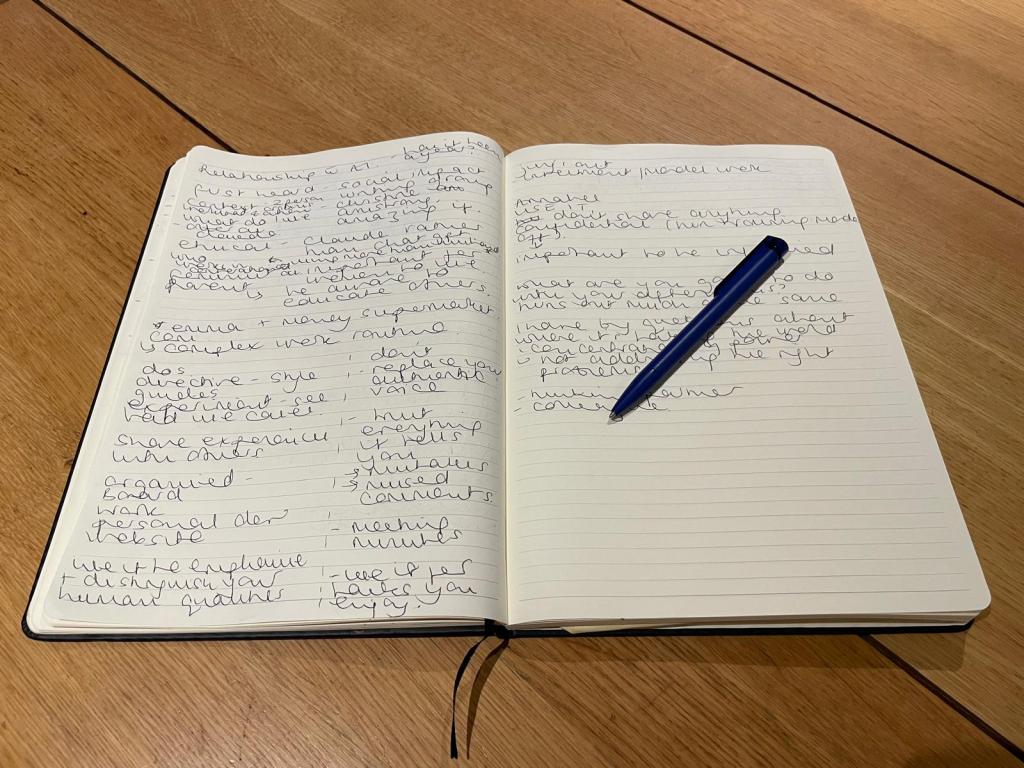
I even used AI to help structure this article you’re reading. That felt uncomfortably meta – using the thing I’m conflicted about to write about my conflict! But I guess that captures exactly what I’m talking about – boundaried usage. I wrote my notes down pen to paper during a rare weekend coffee shop visit, used it as a thinking partner for structure, then wrote everything in my own voice, added my own examples, and improved it iteratively.
It’s become a useful tool for organising information and exploring options – all with the aim of keeping up with the wider conversation.
Through all of this though, I’m using AI to emphasise my own strengths, not bypass them and that’s becoming increasingly important to me.
What I Won’t Compromise
Through all this experimenting, I’ve figured out where my boundaries are. Some things aren’t up for negotiation, no matter how useful AI might be.
My voice: My writing is best when it sounds like how I talk – accessible, warm, conversational – with all of my grammatical tics and habits. AI can strip that away frighteningly quickly if I let it – I’ve learnt that through trial and error. I’ve published posts that were too AI-polished, where I let it smooth away my voice because I didn’t know better yet. So I’ve created style guides…I feed Claude examples of my natural, unfiltered writing and I’m super directive about what I want. I also check EVERY SINGLE THING it produces because I’ve learned it will remove the parts of my writing that make it mine. I’m also cautious about when I use it – think incrementally paragraph by paragraph or for targeted feedback rather than a full draft or re-write.
Running my own race: So much about the AI conversation is about pace. It could be tempting to use it to churn out daily content. Through experimenting, I’ve found what works for me. It’s important that what I write is from the heart and so weekly publishing is where I’m at – and let’s be honest, having a tool I can use for feedback and to get me off a blank page helps enormously, especially when I sit down to write after a long day of work & kids.
Tasks I enjoy are still mine: Although I could, I’m absolutely not delegating the simplistic stuff I actually enjoy. Generating ideas for writing is a creative release. Diary planning brings me satisfaction. Plotting my to-dos across the Eisenhower Matrix creates space. I’m not handing any of those over. These are tasks that bring clarity and perspective as well as enjoyment.
Genuine connection is currently better offline: I’m missing the spontaneity and human quirks in online spaces right now. I know people use AI for all sorts of reasons – time pressure, lack of confidence, accessibility needs – and those are all valid but please remember that your real, human voice is needed. Until the online world finds its balance (if it even will?), I’m prioritising more face-to-face conversations for real connection.
Your reflection: What parts of your work or life would you never want to automate, even if you could?
Where I’m Still Figuring It Out
I haven’t found a way to incorporate AI into the deal process yet. The investment and financial modelling work and the technical analysis that’s central to what I do at Greater Cambridge Impact – I’m not convinced there’s a role for AI there that doesn’t introduce more risk or more work than value.
Maybe that’s where I draw the line? Maybe it’s about keeping AI in the spaces where it’s genuinely useful for efficiency and thinking, but out of the spaces where judgement and expertise matter most.
Three principles guide me, borrowed from Annabel Gillard:
- Use it – it’s important for women to engage
- Don’t share anything confidential
- Challenge it
That third one matters most. Question everything it tells you.
The Bigger Picture I Can’t Resolve
I have serious questions about where AI is heading on a global scale. The concentration of power in a few tech companies. Whether it’s being used to solve the world’s biggest problems or just to make certain people wealthier. How much conversation there is about the real risks and the true consent we’ve provided as it becomes more prevalent. The list goes on.
I don’t have answers to these questions. Writing this article doesn’t resolve the tension between my concerns and my use of AI.
But I do think it’s important to be informed. To engage thoughtfully rather than either running toward it enthusiastically or away from it in fear.
My LinkedIn feed will probably keep filling up with AI-generated content. I’ll keep missing the authentic voices. And I’ll keep using AI in limited, boundaried ways while staying uncomfortable with the bigger implications.
That’s the honest truth of where I am with this.
Questions for Your Own Reflection
- What would it look like to engage with AI on your terms, not on tech companies’ terms?
- Where could AI genuinely save you time in ways that free you up for work that matters more?
- What aspects of your work or communication style are you most protective of?
- Who in your network might benefit from a conversation about how to use AI thoughtfully?
- What would you need to feel more informed about AI without feeling overwhelmed by it?
Let’s Talk About This
I’d genuinely love to hear how you’re navigating this. Are you using AI? Avoiding it? Feeling conflicted about it?
What boundaries have you set? What has surprised you about using it – or about not using it?
This feels like one of those topics where we should start talking more fully and openly about what we, and our companies are and aren’t doing and about the messy middle ground between enthusiasm and rejection
Thanks to Emilie Goodall and the Women in Social Finance gang for prompting these reflections. Always an inspiring community!




 Faye McDonough
Leave a comment