Success used to look like a corner office and a company car. Now it’s personal.
When I started my professional career in finance in the South Manchester office of a high street bank, the corner office and a company car were ‘The Dream’. Not just mine but everyone’s, it seemed.
Validation of your success such as Share Save schemes, monthly and annual bonuses and overseas trips for Achievers Dinners dominated conversations. I can still remember the buzz in the office when the standard company cars were upgraded to Mercedes Benz. The excitement was palpable. It was talked about for months in anticipation of the first deliveries.
When I handed in my notice three years later for a new opportunity, the first thing my boss said to me was “But Faye, what about your pension?” I’m not sure if I said it out loud but I’m pretty sure I was thinking – ‘Who cares, I’m 26!’
A successful banking career in the early 00’s meant a 45-50 year commitment from school leaver to pensioner. I learned a lot, good and bad from those that followed this path. I’m incredibly grateful for that but things have changed.
Success looks very different these days, and not just because I’m older. It’s personal. Personal to you, your values, your experiences and your aspirations and even your generation.
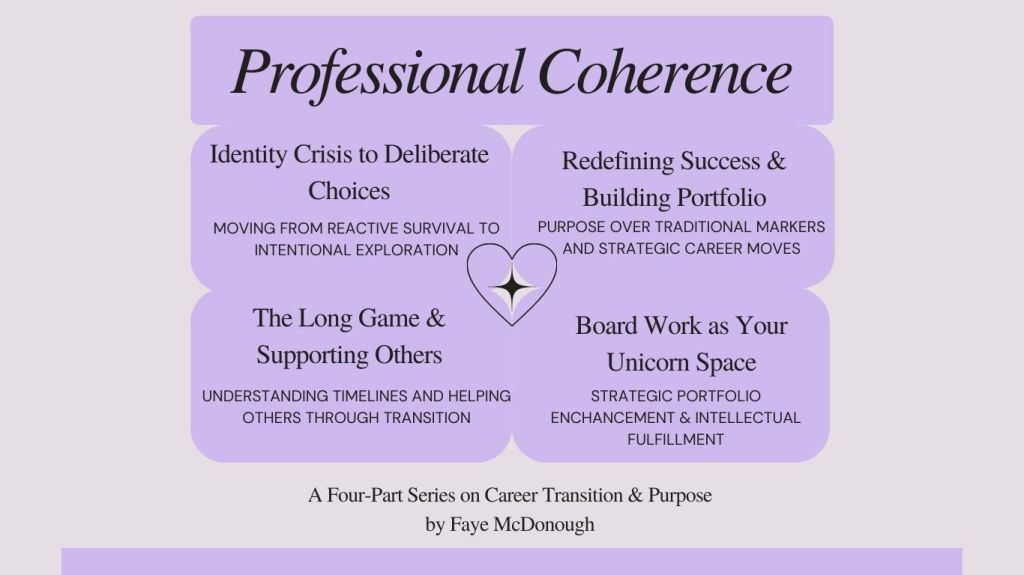
In this second part of my series on Professional Coherence, I’m sharing how you can redefine what success means to you and build a portfolio of work that matches that vision, shifting from reactive to strategic career planning.
The Foundation: Self-Awareness as Your Starting Point
Everything begins with self-awareness. If you don’t understand your strengths, values, and what energises you, you’ll keep accepting opportunities that look good on paper but feel wrong in practice.
I’ve become evangelical about feedback and self-assessment tools. Myers-Briggs, StrengthsFinder, 360 reviews, the list goes on – I take every opportunity to understand myself better. Not because I believe these tools are perfect (they’re often not), but because they give me language to articulate what I bring to work and what I need to thrive.
The investment in understanding yourself pays dividends when you’re making career decisions. You can explain not just what you’re good at, but what kind of environment brings out your best work. You know which challenges excite you and which drain your energy.
This can be through using formal self-assessment tools, but it can also be as simple as asking friends, family and colleagues what comes to mind when they think about you.
Your reflection: When did you last actively seek feedback about your working style and strengths? What tools or conversations could help you understand yourself better?
What Success Actually Means Now
The shift in how I define success didn’t happen overnight. Since first leaving Large Corporate High Street banking 8 years ago, I’ve gradually moved from chasing external validation to seeking internal alignment.
Wrestling with the identity crisis brought on by my first redundancy and through working with a coach, I created what I call my “ideal job list”. It’s as simple as it sounds: a maximum of ten things I’m looking for in a role, distilled into a sentence that I can easily share and include on my LinkedIn profile.
It’s a reflection of the working style and strengths identified through self-awareness and feedback translated into a dream role. A way to constantly feel like you’re working in flow rather than against the grain.
The criteria evolves as I do but the essence is the same; my ideal job is a leadership role in a scaling Financial Services business with strong foundations and a people-focused culture where I can learn something new, add value and make a difference, ideally improving people’s lives.
This clarity has guided some of my biggest career decisions.
When I made the switch from large corporate banking to smaller financial services businesses, I was looking to get back to teams where I knew everyone’s name, could effect change and make real decisions. I’d experienced that environment early in my career, but as companies grew and structures became more complex, I wanted to find that again.
I assess every job description and application against this list. You won’t be surprised to know that it leads to fewer, yet more specific and tailored job applications. It’s also become my North Star for decision-making – if I start to focus on those traditional markers of external validation, my simple list keeps me honest and on track.
But it was the conversations with recruiters after my second redundancy that really crystallised this change. I found myself turning down conversations about roles that offered the ideal financial package but didn’t align with what I’d discovered mattered to me: the opportunity to create calm from chaos, to lead authentically, to build foundations for growth and most importantly to lend money with purpose.
Whilst I still believe in the power of supporting the UK SME community with the funds they need to grow, tightening credit markets and difficult economic conditions only narrowed the pool of businesses that met lending criteria, leaving funds only available for the already successful. It felt like I was working to make the same wealthy people wealthier all the time.
There is absolutely a role for that in the economy but I’d slowly realised that what made me tick was reaching underserved organisations with the money they need to grow. What was most important to me was that this money could transform lives and do good. Purpose had climbed to the top of my list.
Taking a lower salary to get what was most important to me felt revolutionary at the time but that’s what I did in choosing to work in Social Finance. My ego took a bruising and it didn’t always make for easy conversations at home (worthy of its own article – it’s on the list), but now that a few years have passed, transitioning my career to one of purpose is one of my greatest achievements and I know my family are equally proud.
Creating clarity from this super simple exercise revisited regularly over time means I can spot when opportunities align with my values rather than just my bank account. It’s changed how I navigate conversations with recruiters, how I evaluate new projects, and how I think about career progression, how I talk to my team about their own career aspirations… I could go on.
Your reflection: What does success actually mean to you now versus five years ago? What has shifted in your priorities?
Building a Portfolio That Reinforces Purpose
What I’ve learned about building a professional portfolio: your “extra” roles shouldn’t be extra at all. They should reinforce and strengthen your main career path.
My Non-Executive Director and Board Trustee roles serve multiple purposes. Yes, giving back matters enormously, but they’ve also become a way to translate my banking and finance experience into something more tangible to the outside world. A way to take ownership of my skillset.
Working in Financial Services can feel like having the original Chandler Bing* job – people either assume you work in a branch or that you’re a City stereotype. Once you start talking about commercial lending, portfolio management, or venture debt, you’ve lost most people entirely. But through board roles, I can demonstrate the breadth of what financial services teaches you: strategy, execution, leadership, change, governance and risk management, digital transformation – all in a people-focused industry.
These roles have broadened my experience, connected me with different sectors, reminded me of skills I’d undervalued, and made me appreciate the incredible grounding that banking and finance have given me. They’ve become integral to my professional identity and a way to show what financial services experience really means.
The compound effect is real. Skills I’ve developed through board work have made me better at strategic thinking in my main role. Networks I’ve built through community involvement have led to unexpected opportunities. Perspectives I’ve gained from working with different organisations and different leadership teams have enriched how I approach challenges.
This isn’t about being busy for the sake of it (I definitely don’t need that!) Rather it’s about being intentional with how different parts of your professional life support and strengthen each other.
Your reflection: How could your current “extra” commitments strengthen your main career path? Where do you see synergies you haven’t fully explored?
The Courage to Say No
Last year, I realised the balance wasn’t right in our house. My limited spare time had gradually been replaced with my family’s hobbies – mainly their interest in football.
My motivations were good; I was doing it to spend time with them and learn about what they enjoy. But somehow, I’d forgotten me and in doing so, lost the time I needed to follow my own interests – to be in what Eve Rodsky calls my Unicorn Space.
Less spare time meant less time to work on the things that light me up – and as I’ve spent more time curating a professional life that I’m passionate about, that often meant creating, preparing my Board meeting contributions, reading or writing.
So I announced that I was having a season off from football. No Premier League, no Champions League, no Sunday Night Serie A. That one season has extended to two but most importantly, it’s also created the space for me to say ‘No’ more often and prioritise what’s important to me.
It has been transformational – not just for me, but for all of us. I occasionally dip back into transfer gossip but when the match is on, I’m somewhere else. That might be fitting in a few lengths at the Jesus Green Lido but equally, it could be in another room. Someone usually comes to join me where there are 90’s tunes, creativity is in full flow, pen is put to paper and many of the ideas I write about here come to life.
This football story has become my recent career metaphor. What are you saying yes to that’s actually taking you away from what energises you? What would you need to stop to make space for what truly matters?
Self-awareness and an inventory of your ideal work are the foundation for these choices. When you know what fills you up versus what drains you, saying no becomes an act of self-preservation rather than selfishness. Another perfect example of why both are foundational.
Your reflection: What could you stop to start doing something that truly energises you? Where have you been filling time with ‘shoulds’ rather than choices?
The Ongoing Practice of Realignment
Redefining success and building your portfolio shouldn’t be a one-time exercise. Ideally, it’s an ongoing practice of checking in with yourself and making adjustments as you grow and change.
I review my ideal job list regularly. I assess whether my portfolio of roles still serves my goals. I notice when I’m saying yes to things that don’t align with my values and course-correct.
The beautiful thing about this approach is that it gives you agency – essential after a significant career disruption. You’re not just responding to what’s offered to you. You’re actively creating a professional life that reflects who you are and what you care about.
Questions for Your Own Reflection
Whether you’re actively job searching or simply thinking about professional alignment:
- What would success look like if no one else was watching? Remove the external validation and focus on what actually matters to you.
- Which of your current commitments serve your goals, and which serve other people’s expectations? Be honest about where you’re spending energy.
- How could you build a portfolio of roles that reinforce each other? Look for synergies between different parts of your professional life.
- What feedback or self-awareness work could you do now to better understand your strengths and values?
- If you had to choose just three professional priorities for the next year, what would they be?
In my approach, the goal isn’t to have the most impressive-looking career on paper. It’s about building a professional life that energises you, aligns with your values, and creates the impact you want to make in the world.
Next week, I’ll explore the final piece of professional coherence: understanding the long game and how supporting others through their transitions becomes part of your own ongoing journey.
What’s your experience with redefining success? I’d love to hear how you’ve shifted your own metrics and what you’ve learned about building a portfolio that truly serves your goals.
This is Part 2 of a four-part series on Professional Coherence. You can read more at fayemcdonough.com and join the conversation about career development, leadership, and finding purpose in your professional journey. Add your email to be notified when I publish and feel free to share with anyone who may benefit.
You can read Part 1 here and Part 3 here
*Reference to a legendary character in the TV Series, Friends – just in case…






 Faye McDonough
Leave a reply to Professional Coherence Part 3: The Long Game & Supporting Others – Faye McDonough Cancel reply