Three years felt like forever when I was in the middle of it. But actually, it has been the perfect timeline to refocus my career.
In fact, if I look back it might even have started seven years ago…
When I first faced redundancy in 2017, I felt this overwhelming pressure to rush into the next role. The fear was real and immediate, driving everything I did. I needed to find something quickly, anything that would restore the security and identity I’d lost. I just wanted to be able to say I was working again. But somehow my values cut through the panic, helping me to pause and, in the end, choose something that was actually the right fit.
Someone said to me recently that I’d “landed on my feet” after my second redundancy in 2022 and it struck me how wrong that felt. Landing suggests something quick and neat, like I’d simply bounced back. But that’s not how it happened at all.
Writing about and acknowledging two redundancies in five years makes me pause. There’s still a part of me that worries how that sounds. But I’ve learned that redundancy reflects economic decisions and organisational changes, not personal performance or worth.
Those two jolts to my career have reshaped it in ways I didn’t expect. Now with some perspective, I wouldn’t change it for a thing.
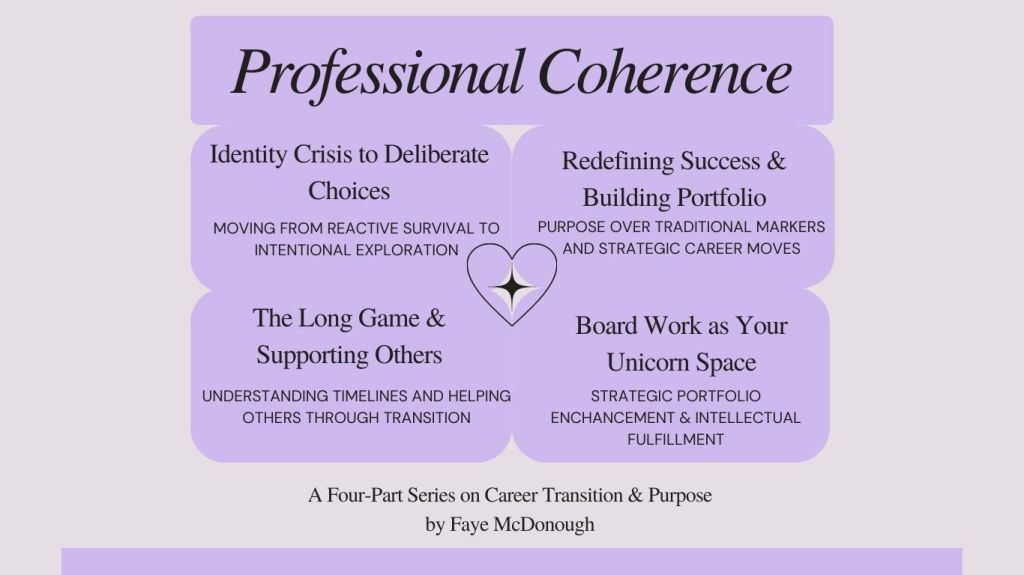
This is the third part of my series on professional coherence, and it’s about the elements that only become clear with time: why career disruption needs space to unfold, how your journey creates ripple effects for others, and the responsibility that comes with navigating change successfully.
Why Professional Coherence Takes Time
The timeline for real career transition is longer than anyone tells you. Much longer than feels comfortable. It might start with the practical elements – building selfawareness, asking for feedback, creating your ‘ideal job list’, updating your CV, looking at roles, rebuilding your confidence.
When I first experienced redundancy, I thought coherence meant having a clear plan and executing it efficiently. What I couldn’t see was that the real work was happening underneath the surface, and more importantly, that it would take time.
It all came together incrementally. At one month, I was starting to understand what I didn’t want. At six months in, I was getting clearer on my values and what success looked like for me personally. After a year, I was building something that felt genuinely mine. It’s only now, years later, that I can finally see how all the pieces fit together.
The compound benefits only show up over time. The network you build slowly. The confidence that grows step by step. The clarity that emerges through experimentation rather than analysis. The opportunities that arise because you’ve been patient enough to stay open to them. The connection that comes from sharing honestly.
Your reflection: What would change if you gave yourself permission to take the time you actually need?
This isn’t just true for redundancy. Any significant career disruption (whether it’s a role that doesn’t work out, a career change, an awful workplace experience or simply feeling stuck) benefits from a longer view.
For most people, professional coherence isn’t a destination you just arrive at. There’s no finish line in sight, and whilst that might be daunting at first, the real value is in an ongoing practice of aligning your choices with your values and an evolving understanding of what success means to you as you change too.
The Ripple Effect of Honest Sharing
What surprised me most about sharing my redundancy journey was how it gave others permission to be honest about their own career challenges.
When I wrote about my experience on LinkedIn, I started receiving messages from people who’d been through similar transitions.
E shared her story of how reading my post prompted her to approach redundancy differently, more bravely with hope and positivity – it’s been brilliant to see this evolve over time as she’s navigated career transition confidently.
C talked about his experience of redundancy and the loss he felt in terms of peers and network. How he’d appreciated my honesty in sharing the loneliness that often follows, how it’d made him reevaluate his choices, and reconnect with those he missed.
Conversations started on and offline because I’d been willing to be honest about the difficult bits, alongside the positive outcomes. This taught me something important: your willingness to share your struggles in a way that works for you creates space for others to acknowledge theirs. In a professional world that often feels like one good news announcement after another, authenticity becomes a gift you can give to others.
The responsibility that comes with having navigated career disruption successfully isn’t about having the answers; it’s not that straightforward. But it absolutely is about being honest about the questions you’re still asking. It’s about being intentional with the uncertainty. It’s about showing that professional coherence isn’t about having it all figured out.
Your reflection: How has someone else’s honest sharing about career challenges helped you?
Paying It Forward
I now keep a running list of resources for people facing redundancy or career transition. I don’t have all the answers, but I do remember how overwhelming it felt to start from scratch.
This is a list of resources that have all helped me to create space for new ideas:
UPFRONT’s BOND programme is often free for women experiencing redundancy. I’ve written about this ace learning and development programme before.
Desert Island Discs episodes featuring stories of resilience provided escapism and inspiration – Shirine Khoury-Haq‘s story of leadership through adversity and baby loss, Lord Simon Woolley’s journey from council estate to the House of Lords and Donna Ockenden’s purpose-driven career rooted in heartbreaking events have all nourished me during difficult moments.
Books that shifted my perspective on success and time, like Emma Gannon’s “The Success Myth” and Oliver Burkeman’s “Four Thousand Weeks.”
There are more I could mention but the most valuable thing I can offer isn’t a list of resources. It’s perspective.
The knowledge that career disruption can be a catalyst for growth, not just a setback. That taking responsibility for your situation while asking for support isn’t contradictory. That gathering feedback and building your network during transitions creates foundations that serve you long after you’ve moved on. And perhaps most importantly, that there is never anything to be ashamed of if your career isn’t working out quite like you’d want it to.
Your reflection: Who could benefit from hearing about your career journey, and how could you share it?
Supporting others through career transitions also reinforces your own learning. Every conversation I have keeps me connected to the reality that career development is ongoing work for all of us.
What Professional Coherence Looks Like Now
Looking back across this series, professional coherence emerges from three interconnected elements: making deliberate choices about your career direction, redefining success on your own terms, and maintaining a long-term perspective that allows for growth and change.
It’s not about having a perfect plan or never experiencing uncertainty. Let’s be honest, change is inevitable in any career. It’s about developing the skills to navigate uncertainty with intention. It’s about building a career that feels genuinely and honestly yours, even when – especially when – it doesn’t look like anyone else’s path.
The difference between “landing on your feet” and “learning to walk with intention” matters more than I initially realised. Landing suggests luck, accident, something that happens to you.
Learning to walk is deliberate, practiced, something you develop over time and something that acknowledges the inevitable ups and downs. It’s a much more honest description of long-term sustainable career development.
So what would I tell someone just starting this journey? These are the insights that have made the biggest difference for me.
Five Things I’ve Learned About Career Disruption
- Career disruption can be a catalyst for growth – There’s not only life after redundancy or career challenges, but genuine opportunity to reset and rebuild on stronger foundations.
- Don’t be afraid to ask for support – The strength I found through sharing my experience taught me that vulnerability and professional credibility aren’t mutually exclusive.
- Take responsibility for your situation – Creating detailed examples of your expertise, pausing to consider your next phase thoughtfully, and growing your network helps you feel in control during uncertain times.
- Career control often leads to life control – Taking ownership of my professional development led to taking better care of my wellbeing, which continues to benefit me years later.
- Document as you go – Always keep records of your work, skills development, relationships, and positive feedback. This foundation becomes invaluable during any transition.
Questions for Your Own Reflection
- Who supported you during your biggest career transition, and how could you pay that forward to someone currently navigating change?
- What timeline are you working on for your current goals? Are you rushing something that would benefit from more patience and space?
- How could you be more honest about your career challenges in ways that might help others feel less alone in theirs?
- What resources, knowledge, or perspective do you have that could benefit someone earlier in their career journey?
- How will you maintain professional coherence as your career continues to evolve and change?
Moving Forward
Professional coherence continues to evolve as your career progresses. It isn’t about perfection, avoiding uncertainty or reaching an aspirational finish line – all are impossible anyway.
The questions change, the priorities shift, but the practice of aligning your choices with your values and what is really truly and honestly important to you remains constant. The skills you develop navigating one transition become the foundation for handling the next ones with greater confidence and clarity.
Whether you’re currently facing career disruption, feeling stuck in your current role, or simply thinking about your long-term professional development, the principles remain the same: make deliberate choices, define success for yourself, and give yourself the time and space that meaningful change requires.
If you’ve been through redundancy, a significant career change, or any period of professional uncertainty, I’d love to hear about your experience. What did you learn? What would you tell someone just starting that journey?
Your story might be exactly what someone else needs to hear.
This is Part 3 of a four-part series on Professional Coherence. You can read more at fayemcdonough.com and join the conversation about career development, leadership, and finding purpose in your professional journey. Add your email to be notified when I publish and feel free to share with anyone who may benefit.
You can read Part 1 here and Part 2 here






 Faye McDonough
Leave a reply to Professional Coherence Part 1: From Identity Crisis to Deliberate Choices – Faye McDonough Cancel reply