Ever wondered about board work but dismissed it as something for other people?
I used to think the same way. When I pictured ‘board member,’ my mind conjured up leather briefcases, formal boardrooms, and people who’ve been in business for decades. Not very me!
It felt like a world that was both important and impossibly distant – reserved for those with mysterious networking connections or certain credentials I couldn’t quite crack.
Turns out I was completely wrong.
Now, having taken on board roles myself, I can tell you that everyone has something to offer, there are loads of opportunities and plenty of support.
Building on Redundancy’s Silver Lining
I first came up with the idea of seeking board work whilst on my career break post-redundancy in 2022.
If I would continue facing career uncertainty due to inevitable restructures and change, I needed to think differently about my career.
How could I future-proof my skills and get a greater sense of what I can offer as an individual rather than as an employee behind a corporate badge?
I was driven by this and more summarised as a desire to give back to my community, to create greater connections locally, and to test my banking and finance skills in new environments.
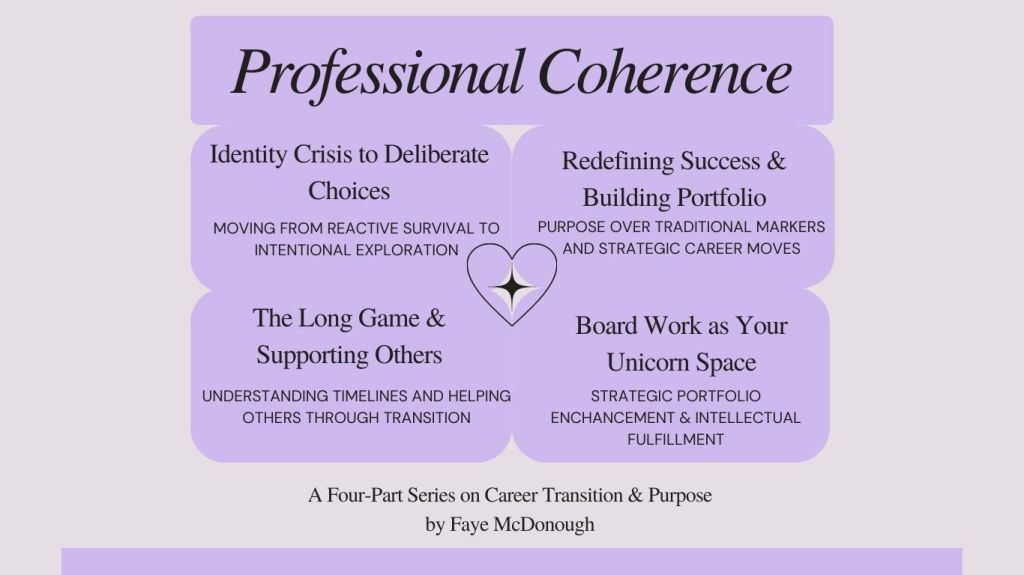
This exploration of board work connects directly to the Professional Coherence journey I’ve been sharing here on fayemcdonough.com.
After redefining success on my own terms and creating a career that reinforces what I enjoy most about work, board work has emerged as part of that portfolio (alongside writing about my career here).
Taking a seat at the board was a natural next step from the volunteering I’d started to do to try out different work identities.
It’s what Eve Rodsky calls my ‘Unicorn Space’ – that intellectually stimulating outlet that energises rather than drains me.
From ‘Extra’ to Essential
In Part 2 of my Professional Coherence series, I wrote about how your ‘extra’ roles shouldn’t be extra at all – they should reinforce and strengthen your main career path.
Board work has become exactly that for me.
It’s helped translate my banking and finance experience into something more tangible while creating the compound effects I mentioned: skills developed through board work make me better at strategic thinking, networks lead to unexpected opportunities, and new perspectives enrich how I approach challenges in my main role
Your reflection: How do your current ‘extra’ commitments reinforce your main career path? Where do you see opportunities to create stronger connections between different parts of your professional life?
What I Wish I’d Known Earlier
I’d always had lots of questions about becoming a board member:
- How does it work?
- How do you find a role?
- What kind of organisation is right for me?
- And importantly, do you only do it when you are retired?
Here are a few things I wish I’d known earlier before deciding to take the leap.
Writing them here as a reminder of what this work brings but also for those of you interested in doing the same.
You Already Have What It Takes
Everyone has something to bring to the boardroom. Your age, experience or sector specialisms are not barriers to offering a critical perspective.
WB Directors always used to share the story of Alison Rose, former NatWest CEO, whose first board role was at a local community group as a young adult and was critical in developing those boardroom skills so important to her future career.
This isn’t unusual – opportunities exist at every level and stage of career. There are many opportunities for positions at organisations of all sizes, paid and unpaid. Everyone I speak to tells me you will find one right for you.
Board roles come in different forms – Non-Executive Directors (NEDs) typically work with companies and are usually paid, while Board Trustees generally govern charities and community organisations on a voluntary basis.
A friend recently shared her experience of applying to become a Board Trustee of a charity whose work she was passionate about. She was sceptical of what she could offer, questioning her abilities and experience. But when the CEO and Chair played back to her what she could bring, she was amazed – they saw potential in her that she’d missed.
This connects back to the self-awareness work I wrote about in Part 2 – when you understand your strengths and what you bring to work, you can see how those skills translate to governance roles too.
The Application Game
For paid NED positions, you can expect a competitive process. Here are some tips for navigating that:
- NED recruitment often seeks a specific skill set to match the organisation’s strategic direction. Be honest in your own assessment of what you bring – do you have what they need?
- Knowing why you want to take on a Non-Exec role is essential but not as important as articulating what you will bring. Be prepared to communicate your USP straight away.
- Brevity is key. Think 20-second pitches, CV achievements demonstrating business benefits, and concise communication in all senses.
Your reflection: How do you currently articulate your unique value in competitive processes? What would help you communicate your professional strengths more confidently?
For voluntary positions with community organisations, these are more important:
- Do you genuinely care about the organisation’s mission?
Trustee roles are voluntary commitments that require sustained engagement over several years. Your passion for the cause will carry you through challenging board discussions, difficult financial decisions, and the detailed work of governance. Without genuine connection to the mission, it becomes much harder to stay motivated and contribute meaningfully to the organisation’s success
- Can you commit to the time and responsibilities?
Trustee roles typically require attending 4-6 board meetings per year plus additional committee work, reading board papers beforehand, and occasionally supporting special projects or events. Be realistic about what you can offer consistently.
- Do you understand the legal responsibilities?
As a trustee, you become legally responsible for the charity’s governance, finances, and compliance. Quite something for a voluntary role! While this sounds daunting, most charities provide excellent induction and ongoing support to help you understand your duties – but it’s worth knowing this commitment upfront.
This clarity about what you bring and what you’re committing to connects back to the self-awareness work I’m so passionate about – understanding your professional identity makes these conversations much more confident and authentic.
A word on finance: Many women I know resist joining boards because of a lack of confidence in reading financials. I want to take a minute to remind you that this is absolutely a skill that anyone can learn.
I get asked “Can I run these numbers past you?” a surprising amount, and I always under-appreciate my confidence with numbers.
But working with financials hasn’t always come easily for me, especially when I’ve switched products and sectors. My last move involved switching from lending to loss-making, high-growth recurring revenue models with multiple investors to charities with restricted funding models – quite different contexts that each required learning new financial frameworks.
But that’s exactly the point – financial literacy is learnable, adaptable, and builds over time. If I can navigate everything from commercial lending to charity restricted funds, so can you.
There are tons of materials out there so choose the learning style that works for you.
But for Board Trustees, Embrace Finance often run reasonably priced workshops on charity accounting with a specialism in building financial resilience which is so important to your role. Liz Pepler also regularly posts her thoughts on LinkedIn – I always learn something new and I know you will too.
Don’t let financial confidence be the barrier that stops you from pursuing board work that genuinely interests you.
Your reflection: What perceived barrier might be stopping you from pursuing opportunities that genuinely interest you? How could you start building confidence in that area?
Finding Your Community
The community aspect of board development reflects something I’ve learned throughout my professional coherence journey – building meaningful connections makes navigating uncertainty much easier.
Here are some reflections on what worked for me:
You can follow top NED profiles on LinkedIn for insight into their work and challenges. Some, such as Karen Thomas-Bland, share their work with incredible generosity. Karen works in the PE-backed market with a specialism in mergers, acquisitions and technology – whilst that might not be what you’re looking for straight away, she offers fantastic insight which will improve your knowledge.
There are several inclusive and supportive communities out there that can help you get interview-ready. Find the right fit for you. I’ve personally felt welcomed and supported while learning from WB Directors (formally Women on Boards UK). They cover everything from coveted paid NED positions to charity and community boards thoughtfully. NCVO also provides fantastic specialist content on charities and the role of a trustee.
Share your board aspirations widely. Your employer must be aligned and supportive and don’t forget to tap into the expertise within your business and network. Friends can also provide tons of insight – I’ve found out so much about my friends other activities since starting this journey. You’d be amazed how many have considered doing something similar or have done it already.
This support network approach mirrors what I wrote about in Part 3 of my Professional Coherence series – when you share your journey honestly and seek guidance from others, you create the foundation for sustainable career development.
What You Really Want to Know
How do you find the time? (You will if it’s your unicorn space!)
This connects back to the courage to say no that I wrote about in Part 2. Remember my football story? When board work becomes your unicorn space – that intellectually stimulating outlet that energises rather than drains – you naturally make time for it. The preparation doesn’t feel like a burden because you’re genuinely engaged with the work.
That said, be realistic about your capacity. Board work requires consistent commitment over several years, not just when it’s convenient. If you can’t commit properly to the time requirements, it’s better to wait until you can.
How to balance contributions when it’s your professional reputation at risk
Board work carries real reputational responsibility, especially in challenging situations. I’ve learned that you need to be prepared to ask difficult questions and provide oversight even when it’s uncomfortable – that’s actually why you’re there.
The key is ensuring your board roles align with organisations where your governance approach is valued. If you find yourself in situations where your risk management perspective isn’t welcomed, or where the working relationship becomes strained, it may be time to reassess whether that particular role serves your professional development goals.
Your reputation is built through consistent, professional contributions over time. Choose board positions where you can contribute meaningfully and where your input is genuinely valued rather than merely tolerated.
What makes board work genuine unicorn space is how it stretches your thinking beyond your day job while deepening your core skills. I’m solving governance challenges for charities one week and growth strategy issues for businesses the next, all while strengthening the risk management and strategic thinking that make me better in my primary role. It’s intellectually stimulating work that feels like a creative outlet rather than another commitment.
Your reflection: What’s your unicorn space – that intellectually stimulating outlet that could complement rather than compete with your main career?
Building a Professional Portfolio
Board work isn’t something you add randomly to your CV – it should be a deliberate choice that strengthens your professional coherence.
Like the portfolio approach I wrote about in Part 2, the key is ensuring each element reinforces the others.
Board work allows you to demonstrate your expertise in new contexts while building skills that directly benefit your main career, creating the compound effects that make your professional story more compelling and coherent.
Questions for Your Own Reflection
- How does board work fit with your vision of professional coherence?
- What unique perspective or skills would you bring to a governance role?
- How do you think about expanding your professional portfolio beyond your main role?
- What attracts you to the idea of governance and oversight responsibilities?
- How would you integrate board work with your existing professional commitments?
Community Engagement
Experienced NEDs in my network – do you have anything else to add? What am I missing?
Anyone else thinking of taking the leap?
How are you thinking about building professional coherence in your own career? I’d love to hear about the portfolio elements you’re considering or already developing.
This is Part 4 of my ongoing Professional Coherence series – you can read the earlier posts about deliberate career choices, redefining success, and supporting others through transitions at fayemcdonough.com



 Faye McDonough
Leave a comment